From the Bronx to Berlin: How Graffiti Became a Global Movement
Graffiti’s move beyond New York was not a single event but a slow leak, carried by photographs, documentaries, and travelling writers, into cities with completely different walls, trains, and laws to work around. By the time it had spread across Europe and beyond, graffiti was no longer one movement but a family of local scenes, each shaped by what its own city made possible.
Photographs travel faster than people
Long before international flights were common for teenagers, books and photo collections documenting New York’s painted trains circulated among small groups of curious readers overseas. A single widely seen photograph of a full car could do more to spread a style than any writer’s actual visit, because it let people study proportions, coloring, and letter construction at their own pace.
Film as a recruitment tool
Two productions did more than anything else to turn interest into imitation: a low-budget narrative film following a young writer’s world, and a documentary built almost entirely from interviews with working writers and footage of yards at night. Both circulated on video far beyond their original release, and for a generation of European writers, they functioned as an instruction manual as much as entertainment.
Different cities, different canvases
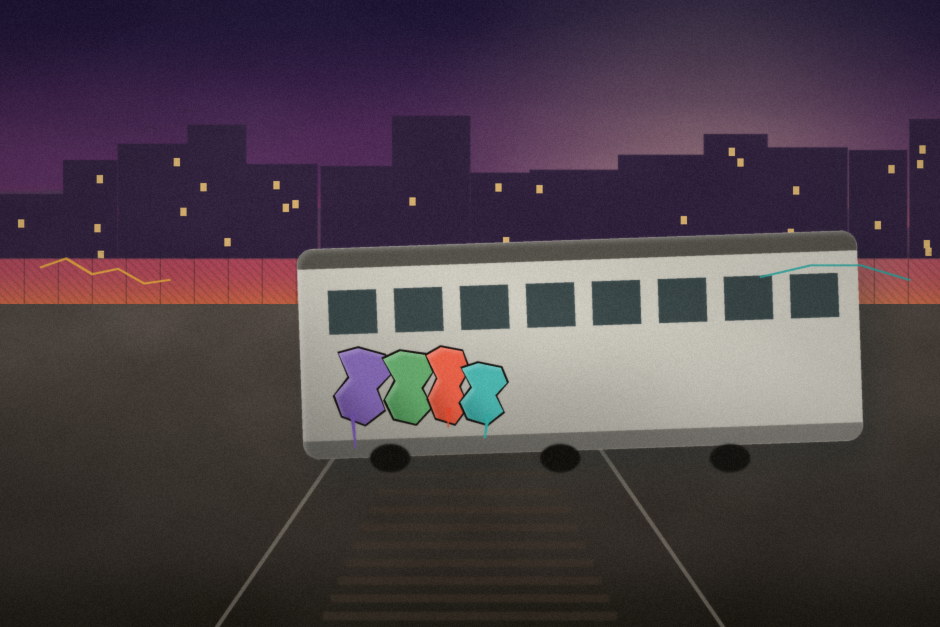
New York’s culture had organized itself around subway cars, but few European cities offered anything comparable. Writers adapted: freight trains that crossed borders and stayed in service for months became a European equivalent, carrying names across countries the way New York’s subway had carried them across boroughs. Where trains were harder to reach, walls, especially large, legally ambiguous ones, took their place.
Politics reshapes the wall
In Berlin, the western side of the Berlin Wall became one of the largest continuous painted surfaces in the world, not because writers planned it that way but because a heavily monitored, heavily photographed barrier turned out to be an ideal stage. Political messages, large murals, and conventional graffiti coexisted on the same concrete, and the wall’s later demolition turned sections of it into some of the most documented graffiti in existence.
Local styles, shared grammar
Every scene that developed kept the core grammar: tags for reach, throw-ups for speed, pieces for reputation. But local materials, local law enforcement, and local taste pushed the visual language in different directions, from tightly wound, character-heavy pieces in some cities to loose, calligraphic styles in others. A trained eye can often place a piece’s country before it can place its author.
One culture, many dialects
What travelled out of New York was never a fixed style but a working method, flexible enough to be rebuilt from scratch wherever a new group of writers picked it up. That is why a piece painted in one city can look almost unrelated to one painted in another, while both writers, if they met, would immediately recognize each other’s process.